Bulbul is a common bird name that even non-birders are aware of. In India there are few bulbul species common in specific terrains.Like Red-vented bulbuls are common in dry areas , so you can see them in Urban outskirts. You cannot stop seeing a Red-whiskered bulbul for a second if you are in a hillstation in South India. If you are in Rajasthan, you can see White-cheeked bulbuls even on a roadside tree. So based on the terrain you can see the commonest bulbul in that area. But not all bulbuls are common, if you take the Grey-headed bulbul even a birder would not have seen them for years unless they visit the forests in Western Ghats. So here we have listed few of the bulbuls that are seen in India.
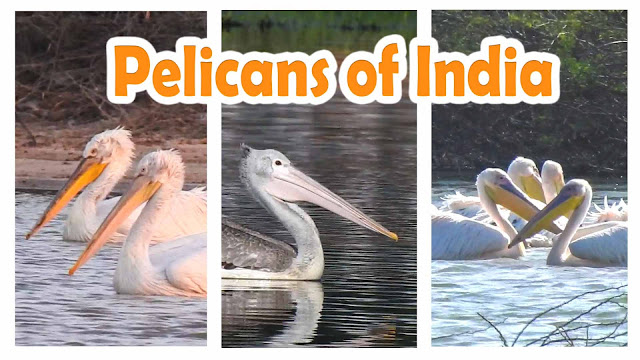
PELICANS OF INDIA Pelicans are large water birds and no one can miss these birds even if they are non-birders. Their beaks are so huge and the pouches are well adapted to catch and swallow fish. The pouches help them to filter the fish. They are one of the heaviest flying birds. There are three pelican species in India. 1. Great White Pelican 2. Dalmatian Pelican 3. Spot-billed Pelican In South India, Spot-billed Pelicans can be seen but their numbers had reduced drastically. We saw Great White and Dalmatian Pelicans in Gujarat. Great white pelicans are distributed across many continents and Dalmatian pelicans can be seen in Europe. Dalmatian Pelicans are the largest of the 3 species. All three pelicans are suffering from habitat destruction, reduction in fishes, nesting places and conflicts with humans. Here is a video and facts about these Pelicans.
Sexual Dimorphism in Birds - Male Vs Female In general Sexual Dimorphism is an interesting phenomenon but in birds its visibly delightful factor. The males are usually brighter and bigger than the females. But there are few exceptions like Painted Snipe where the females are bigger and colorful. In Birds of prey, the females are always larger as they catches the prey for their chicks. In few birds like minivets both the sexes are equally colorful. People who don't have any knowledge about birds usually think these birds as different species. Let us start by having a look at our common backyard bird. In the case of Asian Koel , the male is glossy black and female is dark brown with white spots. Sexual dimorphism in ducks is very common. In Northern Pintail, the male is more striking.A thin white stripe runs from the back of chocolate-color head. The female plumage is more subtle. For Pied bush chat males are black with a white vent and a white wing patch. Females ...
Water Birds in India Water birds are birds that live in water. The aquatic habitats could either be fresh water or marine. These birds rely on the water body for their food. These water habitats can be reservoir, marshes, ponds, lakes etc. Based on the different type of habitats and their preferred prey the birds get adapted accordingly. Aquatic habitats are often rich in food sources as water is the cradle of life. From fish to frogs, snakes to eels anything that fits the mouth of a bird is prey. Small waders like plovers go behind worms , insects which are abundant in tidal mudflats. The water birds in Tidal mudflats are mostly the shore birds , herons and kingfishers. The Tidal mudflats are exposed during the low tide and many invertebrates are left behind from ocean. So the birds use that time to feed their food. Western Reef Egret, Dunlin, Spotted Redshank, Eurasian Oyster Catcher, Lesser Sand Plover, Great Thick Knee, Eurasian Curlew, Ruff, Common Green Shank, Black-tailed G...




Comments
Post a Comment